
Recurring client conversations with AI for more insight and less time spent
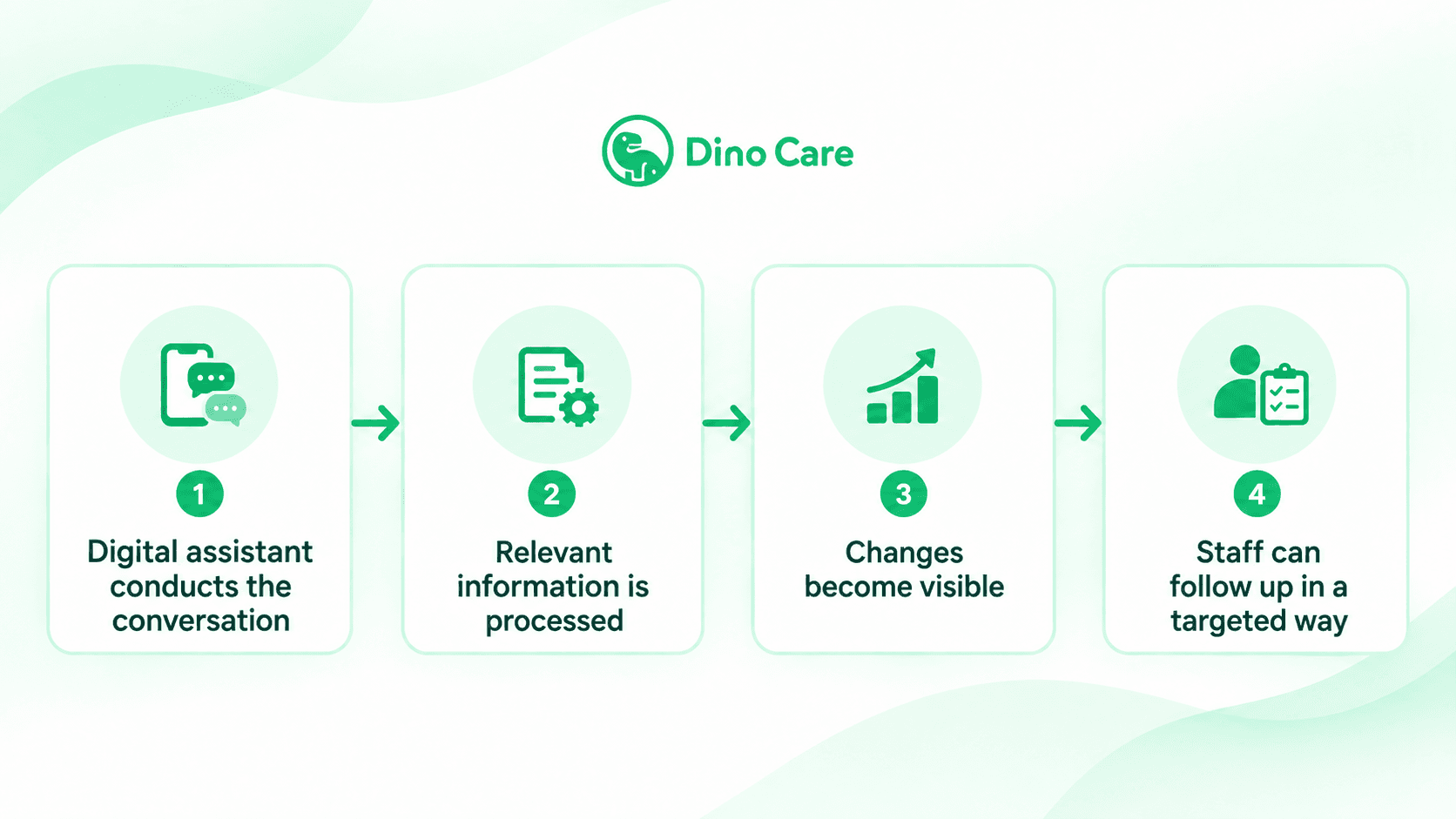
A great deal of valuable information about a client emerges naturally in a conversation. How are things at home? Who visits regularly? Are they still able to do the shopping? And has anything changed since the last contact? Dino Care's digital assistant can conduct these kinds of conversations independently. The assistant asks questions, responds to answers, and then makes relevant information accessible to the care organisation.

Changes become visible earlier
The strength lies not only in one conversation, but especially in what changes over time.
Imagine that a client regularly says that his daughter visits several times a week and helps with shopping and administration. During a subsequent conversation, he says that his daughter has become ill and will not be able to come for the time being.
For a care organisation, that is important information. Not only is social contact lost, but possibly also an important part of the client's informal care network. This could affect the client's self-reliance and support needs. The same applies, for example, when someone goes outside less often, skips activities, sleeps worse, or indicates that daily tasks are becoming more difficult.
The digital assistant can highlight these changes from conversations.
From conversation to automatic documentation and targeted follow-up
Normally, a member of staff has to conduct the conversation, remember or note down relevant information, and then enter it in the appropriate electronic care record.
With the digital assistant, this process happens automatically. The assistant conducts the conversation, processes the answers and records relevant information straight away. Important signals and changes become consistently visible, rather than relying on separate notes or what a member of staff can remember during a busy day.
If a conversation shows that a client's situation has changed, it can prompt targeted follow-up by a member of staff.
Information from conversations is therefore recorded automatically and in a structured way. This reduces the risk of important signals being missed under pressure and helps staff identify more quickly where follow-up is needed.
More contact without proportionally more capacity
Another advantage is that conversations can take place more often without an employee having to be available for every contact moment. That does not mean that personal contact disappears. A conversation with a care professional also has social and human value and remains important.
The digital assistant can provide additional contact moments between those personal moments. This creates more continuity, changes can be noticed earlier, and available care capacity can be deployed more purposefully.
Not only asking more often how someone is doing, but seeing earlier when something changes.